Showing posts with label Hava Nagila. Show all posts

Tuesday, November 11, 2008

Jewish Twists

When Hank Ballard and The Midnighters released a minor blues number they called "The Twist" back in 1959, it was a forgettable b-side. When Chubby Checker covered it a year later, it not only became an a- side single that rose to #1 on the Billboard charts, it became a social event, a culture-spanning dance craze to end all culture- spanning dance crazes-- apologies to all of you still mastering your lambada, electric slide, and Aunt Jackie steps. Thanks to Checker, everybody was dancing The Twist, an entire nation's body turning and bending to a blues shuffle and curing the country of a cultural cancer that Eldridge Cleaver diagnosed as "Bing Crosbyism, Perry Comoism, and Dinah Shoreism." Kids of all colors shook off the vanilla purr of the 50s and The Twist became, in Cleaver's famous words, "a guided missile, launched from the ghetto into the very heart of suburbia. The Twist succeeded, as politics, religion, and law could never do, in writing in the heart and soul what the Supreme Court could only write on the books." Young Jews were key pioneers in the suburban shift of the 50s and key players in the civil rights movement so it's no surprise that they added their own two cents to The Twist's musical legislation. Checker himself made sure that Jews were dancing with him when he re-recorded The Twist to the tune of "Hava Nagilah," even switching between the song's original Hebrew and his own Hava-fied English that invites you to get on the dancefloor.


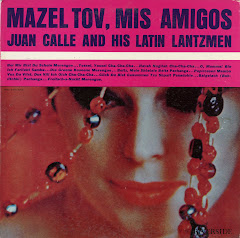
Mambo king Perez Prado was onto the same idea but knowing how much Jews loved the mambo, Prado got rid of the "Hava Nagilah" lyrics and turned it into into a Twist, complete with his signature grunts and sparkling brass section. When it was time for the Twist to "go Latin," Prado knew it also had to "go Jewish."


Of course, Jews themselves chimed on The Twist, none better than the Yiddish Fred Astaire himself, Leo Fuchs. Fuchs is best known for his work on the stages of Broadway and the Yiddish Theater, but we're partial to his Shalom Pardner LP on the Tikva label, where he drops "Yiddish Twist," a bi-cultural stomper that, around 1:20, makes Yiddish speakers get twisting to the sound of-- who else?-- "Chubbele Checker."

Tuesday, August 19, 2008

The H Song, Part Two


Life is full of disappointments, but few compare to dropping the needle on Glen Campbell doing “Hava Nagila” and finding out it’s an instrumental. For weeks, I had been imagining what Mr. Wichita Lineman’s voice would sound like twanging its way through our beloved Hebrew Hallmark card, but alas we only get his legendary country guitarwork. Which is, of course, pretty stellar. Before he was known for having one of the best celeb mugshots ever and for making country Hollywood and pop (is that why when I was kid I always confused him for Fran Tarkenton?), he was one of the 60s most sought after guitarists, a vet of sessions with Sinatra, Presley, Nat King Cole, Jan & Dean, and the Beach Boys. The best part of his 1969 take on on the H Song is that it was released as a 45 b-side to “True Grit,” the theme song to the famed Western of the same name, in which Campbell played the Texas Ranger sidekick to John Wayne’s hard-living US Marshal. The H Song has shown up in the most suprising of places, but being the b-side to gun-slinging “rinches” and badge-flashing Marshals, sharing vinyl with Wayne and Campbell, just might rank as one of its oddest couplings ever.

Thursday, August 14, 2008

The "H" Song: Part One


I should be fair to “Hava Nagila.” The song has been good to us, the standard to beat all standards, theme music that can be used for any show. Plus, it’s been covered by everyone, from Belafonte to Celia Cruz and Dick Dale. Funny thing though is that the song most synonymous with traditional notions of Jewish identity– the Anthem of The Jewish Diaspora, really– is a modern tune cobbled together just after WWI in a Jerusalem musicology classroom by Abraham Idelson and Moshe Nathanson out of a European melody that had become a hasidic nigunim (warning: like the song itself, there are multiple versions of this history floating around and this is just one). Since then, the song has never been the same, changing hands and styles constantly. Its power is in its serious flexibility, its ability to go far beyond being a Hora stomper and cross cultural divides to fit the mold of any genre. The story of the H Song will keep unfolding on this site, so stay tuned. But for starters, check this stab at it by The Spotnicks, a group of sixties Swedes with a Yiddish-inflected band name who were best known for the space suits they often wore, not for managing to get the H Song on the English pop charts.