This album was sent to us by Ollie from Los Angeles. We appreciate its design simplicity and the fact that the artist clearyly foresaw the Sleeveface fad. But who is Benji? His music is pop with a Mediterranean inflexion. But that is all we have to go on. If anyone can shed any light on Benji (a dead ringer for Donald Sutherland if ever there was one) and his career or even connect us to the man himself, we would love to hear from you.
Marcus Goldman's album, Marcus Goldman Orchestra has long been an enigma. Marcus Goldman himself stares from the cover, sphinxlike. Secure in the knowledge that his name is etched across both his signature accordion and the large velvet yarmulke he sports, suggesting he is either extremely forgetful or heavily into personalizing his effects. We are indebted to a reader, Barry Mitchell, who enlightened us via email:
"I know Marcus Goldman posing with his accordion is of particular interest to you. The album actually dates back to at least 1972, the summer I played in a dance trio at Schenck’s Hotel in Fallsburg, NY. Marcus (also known as Alex, which probably accounts for the label’s name, Al-Mar) sold his self-pressed albums while leading the Catskill ladies in afternoon poolside dance lessons. He’d show up, set up his sound system, and blast Eydie Gorme’s “Blame It On The Bossa Nova.” If I remember correctly, the album featured the keyboard stylings of Bob Reisenman, who had the house band at Schenk’s.
It’s the same summer I wrote and performed at Schenk’s, the Evans Hotel, and the Homowack Hotel my parody of Sammy Davis’s then-popular hit, “Candy Man.” (“. . .who makes cherry blintzes, tender, light and sweet? Latkes that are flaky and borscht that can’t be beet? The Flonken Man. . .”)"
Our next challenge in researching this material is to hear about how the listeners encountered the music. If you have any stories at all... please be in touch! We would LOVE to hear them. trailofourvinylATgmail.com
We knew that there was a time when Cantors were the Jewish spiritual world's equivalent of rock stars, when they juggled careers in the synagogue with the bling allure of Broadway and the Opera stage. We knew that Richard Tucker could put out LPs for Shabbat and Yom Kippur one minute, then show up on a Christmas album the next, right alongside Sammy Davis Jr. and Dina Shore. We knew that Bela Herskovitz showed up on This Is Your Life and then played Carnegie Hall with Eddie Cantor. We knew that Cantors played the Catskills just like Tito Puente and Buddy Hackett, only the Cantors got backing from symphony orchestras. We knew that Al Jolson and Harold Arlen were the sons of Cantor fathers and often spoke of Cantorial commonalities with African-American spirituals, blues, and jazz. We knew that Johnny Mathis did his Cantorial best on his own version of "Kol Nidre."
But we had no idea that Yossele Rosenblatt, arguably the greatest U.S. based Cantor of the 20th century (and the highest paid-- he could get up to 15k for a single Yom Kippur gig) was a voice in the head of jazz legend Ornette Coleman. In his fantastic new book, The Jazz Ear, NY Times critic Ben Ratliff sits down with Coleman to listen to music that Coleman chooses. His first pick is a 1916 recording of Rosenblatt singing "Tikanto Shabbos," a mix of crying, singing, and praying that when Coleman first heard it, made him cry. "I said, wait a minute," he tells Ratliff. "You can't find those notes. Those are not 'notes.' They don't exist...I think he's singing pure spiritual. He's making the sound of what he's experiencing as a human being, turning it into the quality of his voice, and what he's singing to is what he's singing about. We hear it as 'how he's singing.' But he's singing about something. I don't know what it is, but it's bad.”
These days it's easy to conflate old-school Cantors with frozen tradition (Warner Brothers wanted the Ukranian-born Rosenblatt to play Jolson's stubborn Orthodox father in The Jazz Singer-- Rosenblatt declined), write them off as symbols of conservatism or insular identity. But Coleman's ears remind us of the great Cantorial legacy in American and Jewish music, re-establishing Cantors as practitioners of avant-garde outness, as spirit voices departing from the soul and heading up and out for what Sun Ra used to call "other planes of there," or in the words of Coleman himself, "something else!!!!"
And You Shall Know Us By The Trail Of Our Vinyl was on All Things Considered this Friday. Our long time love for Melissa Block has reached new levels. Listen here.
And thanks to Josh Spear, the tastebuds of a generation, for spreading the word about this project. Massive stuff.
We have collected so many comedy albums over the past couple of years that at times, it has felt as if they were the only kind that Jews ever recorded... from Rodney Dangerfield's quintessential Shlemiel,The Loser, to the "Bawdy women of Jewish comedy," Belle Barth, Pearl Williams, Totie Fields, and Rusty "Knockers Up" Warren, not to mention the Yinglish maestro, Mickey Katz, and the Jewish jazz tones of Lenny Bruce. Time Magazine, that veritable newssource, had a 1970 lead article dedicated to exploring why "nearly 80% of the top comedians in the country are Jewish." They focussed on the work of clinical pyschologist Samuel Janus who studied 76 different Jewish comics concluding that a life spent in poverty and despair was the crucial step on the road to entertainment success. "What makes them funny, says Janus, is their pain." You don't say... But even we were stumped by this album which has just come in... by Lou Mason, the self-styled "Master of Lafter." His tailored velvet jacket says superstar, but we had never heard of him and can't find a trace of him on the internet. Our first thought was the obvious one -- that he was Jackie Mason's brother. The Dan Swayze to the more famous Patrick, if you will. But we have found no evidence of that, and frankly he looks too self-condifident for that to possibly be. Listen to his sweet repartee. This is his "take my wife, please" bit, which he calls Wives Stories. If any of you can shed light on this mystery, we would be indebted. Please be in touch...
When Hank Ballard and The Midnighters released a minor blues number they called "The Twist" back in 1959, it was a forgettable b-side. When Chubby Checker covered it a year later, it not only became an a- side single that rose to #1 on the Billboard charts, it became a social event, a culture-spanning dance craze to end all culture- spanning dance crazes-- apologies to all of you still mastering your lambada, electric slide, and Aunt Jackie steps. Thanks to Checker, everybody was dancing The Twist, an entire nation's body turning and bending to a blues shuffle and curing the country of a cultural cancer that Eldridge Cleaver diagnosed as "Bing Crosbyism, Perry Comoism, and Dinah Shoreism." Kids of all colors shook off the vanilla purr of the 50s and The Twist became, in Cleaver's famous words, "a guided missile, launched from the ghetto into the very heart of suburbia. The Twist succeeded, as politics, religion, and law could never do, in writing in the heart and soul what the Supreme Court could only write on the books." Young Jews were key pioneers in the suburban shift of the 50s and key players in the civil rights movement so it's no surprise that they added their own two cents to The Twist's musical legislation. Checker himself made sure that Jews were dancing with him when he re-recorded The Twist to the tune of "Hava Nagilah," even switching between the song's original Hebrew and his own Hava-fied English that invites you to get on the dancefloor.
Mambo king Perez Prado was onto the same idea but knowing how much Jews loved the mambo, Prado got rid of the "Hava Nagilah" lyrics and turned it into into a Twist, complete with his signature grunts and sparkling brass section. When it was time for the Twist to "go Latin," Prado knew it also had to "go Jewish."
Of course, Jews themselves chimed on The Twist, none better than the Yiddish Fred Astaire himself, Leo Fuchs. Fuchs is best known for his work on the stages of Broadway and the Yiddish Theater, but we're partial to his Shalom Pardner LP on the Tikva label, where he drops "Yiddish Twist," a bi-cultural stomper that, around 1:20, makes Yiddish speakers get twisting to the sound of-- who else?-- "Chubbele Checker."
Fewer of our finds have been as alluring as the Hannah Ahroni Sings Songs of Israel which we discovered on one of our collecting sorties in the thrift stores of Boca. A beautiful songbird cutting a ripe, exotic, and confident figure, laughing casually against the backdrop of a freshly harvested wheat field. How many young Americans were enticed to move to Israel by this record cover alone when it was released in 1962?
Ahroni (also variously spelled Aharoni and Aroni) was the most succesful of a gaggle of Israeli female solo performers who broke in America at the same time -- Yaffa Yarkoni, Shoshana Damari and Geula Gill were also soulful and stunning -- but there was something about this cover that haunted us and forced us to track her down. When we went round to meet her last week, Uptown in Manhattan, we had the same sense of trepidation as if we were visiting Kathy Ireland or Elle Macpherson.
We are delighted to report, age has dimmed little of her beauty. Her apartment is covered with mementos from a career which saw her play Carnegie Hall, Lincoln Center, and Caesar's Palace which she opened with a month long residence alongside Johnny Mathis. A hallway plastered with album covers was as beautiful to us as anything in the Louvre.
We heard tales of her career which blossomed under the guidance of her manager and husband, the legendary Chaim Tishman, who carefully surrounded her with talent. Tishman persuaded H.B. Barnum, Aretha Franklin's producer, to make A Taste of Hanna (RCA, 1963) the record which made her a household name on American television where she starred in an hour-long special with Paul Anka, and shared a bill for a month with Harry Belafonte at the Hilton Plaza in Miami. Rock out to these two tracks soaked in sobbing vocals and heart-tugging horn arrangements, her version of ATaste of Honey, a song made famous by Herb Alpert, and a haunting version ofHava Nagila.
Hanna's real fame came in South America where her show "An Hour With Hanna Ahroni" made her a legend in Mexico, Argentina, and Brazil. The song which put her over the top, Viva Espana, which she originally recorded as a throwaway during a recording session in Germany, was faintly audible all over Europe in the early '70s. Enjoy it here on German TV and marvel, as the German producers do, in her polyglot abilities...
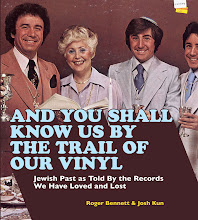
Eight years ago, Roger Bennett and Josh Kun began an important journey, scouring the world to collect thousands of vinyl LPs from attics, garage sales, and dusty archives. Together, once-loved and now long-forgotten audio gems tell a vibrant tale: the story of Jews in America.
 This album was sent to us by Ollie from Los Angeles. We appreciate its design simplicity and the fact that the artist clearyly foresaw the Sleeveface fad. But who is Benji? His music is pop with a Mediterranean inflexion. But that is all we have to go on. If anyone can shed any light on Benji (a dead ringer for Donald Sutherland if ever there was one) and his career or even connect us to the man himself, we would love to hear from you.


+img037+copy.jpg)


 Posts
Posts

